
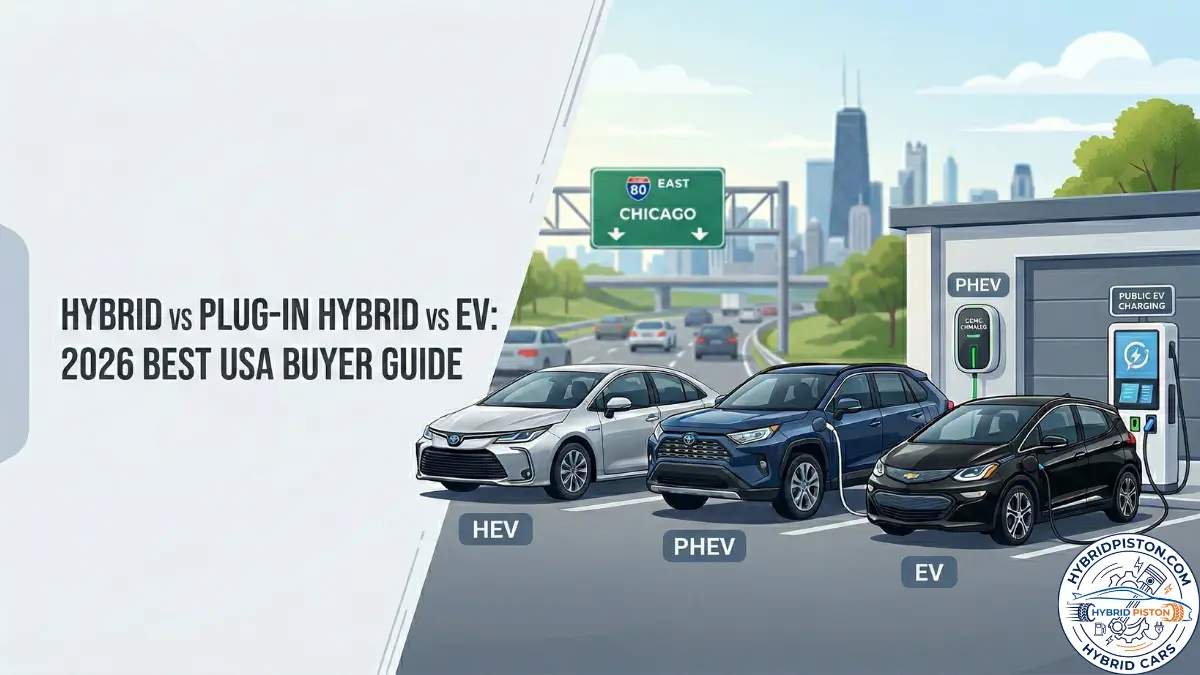
US car buyers in 2026 effectively choose between three electrified powertrains: hybrid (HEV), plug‑in hybrid (PHEV), and fully electric (EV). Each has clear strengths and trade‑offs in price, running costs, charging needs, range, and emissions, so the “best” option depends on how and where the car will be used.
Hybrids are usually cheapest to buy and easiest to live with, PHEVs are great if you can plug in often but still want gas backup, and EVs offer the lowest operating costs when you have reliable charging and drive enough miles. This guide focuses on the 2025–2026 US market and is written for buyers who want a clear, realistic answer not marketing hype.
Quick answer, Which should you choose?
Use this high‑level summary as a starting point, then read the sections that match your situation.
- Choose a Hybrid (HEV) if:
You want better fuel economy with no need to plug in, drive mixed city/highway, and prefer a lower purchase price and simple ownership. - Choose a Plug‑In Hybrid (PHEV) if:
You have home or workplace charging, your typical daily trips are under 20–40 miles, and you still want gasoline backup for long trips. - Choose an Electric Vehicle (EV) if:
You have reliable home charging, drive 10,000–15,000+ miles per year, and want the lowest fuel and maintenance costs with zero tailpipe emissions.
How each powertrain works
Here we discuss hybrid vs plug-in hybrid system, and a EV working as well. if you want to know hybrid car working in detailed then you can check our How hybrid cars work article to deep dive in to this tech.
Hybrid (HEV)
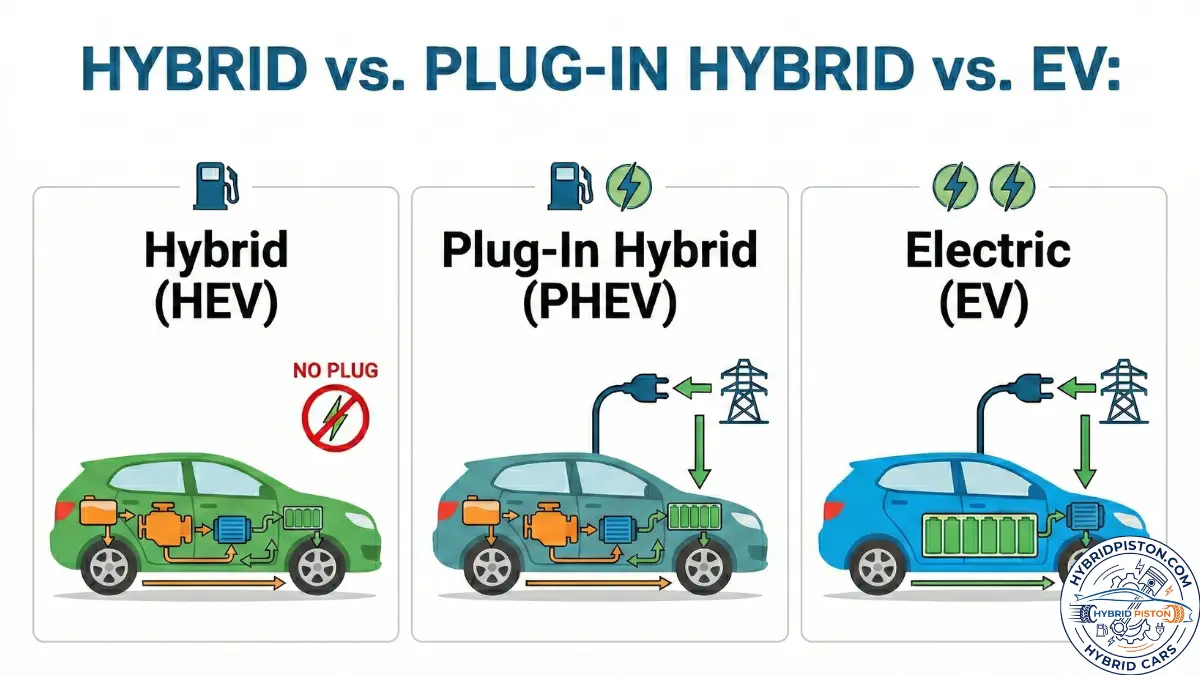
A hybrid pairs a gasoline engine with one or more electric motors and a small battery pack. The battery charges automatically from the engine and from regenerative braking, so you never plug it in.
At low speeds and light loads, the electric motor can sometimes move the car on its own for very short distances, but most of the time the engine and motor work together for efficiency. Hybrids are especially efficient in stop‑and‑go city driving, where the engine can switch off frequently and the motor recovers a lot of braking energy.
Plug‑in hybrid (PHEV)
A plug‑in hybrid also has a gasoline engine, electric motor, and battery but the battery is much larger and can be charged from an outlet or charging station. Depending on model, PHEVs typically offer 20–50 miles of electric‑only range before the engine needs to help.
Used correctly i.e., charged regularly PHEVs can do most local driving on electricity alone, with the engine acting mainly as a backup for long trips or when the battery is empty.
Battery‑electric vehicle (EV)
A battery‑electric vehicle (EV or BEV) has no gasoline engine at all; it uses a large battery pack and one or more electric motors as the sole power source. You must plug it in, either at home, work, or public chargers.
Modern EVs commonly offer 200–350+ miles of range on a full charge, depending on battery size and model. Because they eliminate the engine, transmission, and exhaust system, EVs tend to have lower energy and maintenance costs per year than hybrids or gas cars.
Key differences at a glance
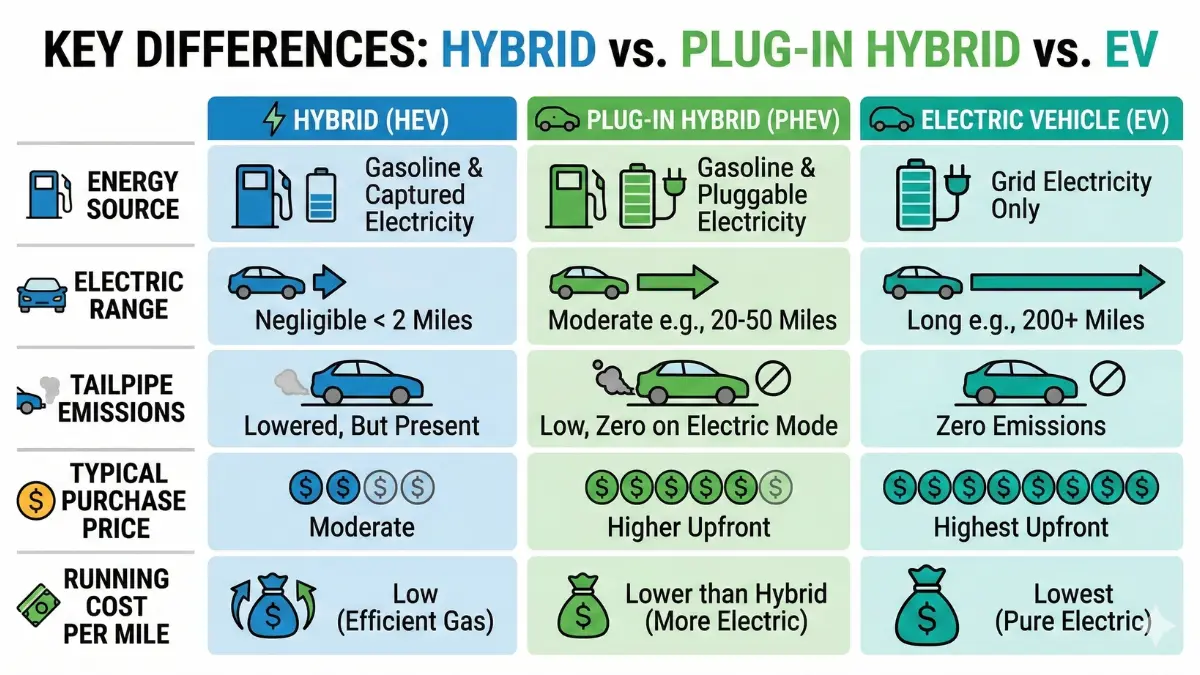
| Feature | Hybrid (HEV) | Plug-in Hybrid (PHEV) | Electric (EV) |
|---|---|---|---|
| Primary energy | Mostly gasoline with electric assist | Electricity for short trips, gasoline backup | 100% electricity |
| Battery size | Small | Medium | Large |
| Plug‑in required | No | Yes (for full benefit) | Yes |
| Typical EV‑only range | 0–3 miles at low speed | ~20–50 miles | 200–350+ miles total |
| Tailpipe emissions | Lower than gas car | Very low if charged often | Zero tailpipe |
| Purchase price (new) | Lowest of three on average | Higher than HEV | Often highest |
| Running cost per mile | Lower than gas, higher than EV | Between HEV and EV | Lowest with home charging |
| Complexity | Engine + hybrid bits | Engine + large battery + charger | Simplest powertrain |
Price, incentives, and ownership cost
In 2026, the real difference between hybrids, plug‑in hybrids, and EVs often shows up more in upfront price, incentives, and total ownership cost than in the driving experience. Before choosing a powertrain, it’s smart to compare what you’ll actually pay to buy, fuel, maintain, and insure each option over at least five years not just the window‑sticker price.
Purchase price in the 2025–2026 US market
New hybrids in 2025 have average transaction prices just under 40,000 USD, typically only a modest premium over comparable gas‑only models. By contrast, many new EVs especially crossovers and trucks still carry several thousand dollars higher MSRPs, even though prices have eased compared with early years.
PHEVs often sit between hybrids and EVs, or close to EV prices, because they combine a full combustion powertrain with a sizable battery and charging hardware.
Federal tax credits and state incentives
In 2026, many EVs and some PHEVs may qualify for US federal tax credits and state‑level incentives, but eligibility depends on battery size, MSRP caps, final assembly location, and buyer income. Regular non‑plug‑in hybrids generally do not qualify for federal EV tax credits.
Because incentive rules change frequently, shoppers should always confirm eligibility on the IRS clean‑vehicle pages and their state energy or transportation sites before counting on credits to close the price gap.
Total cost of ownership snapshots
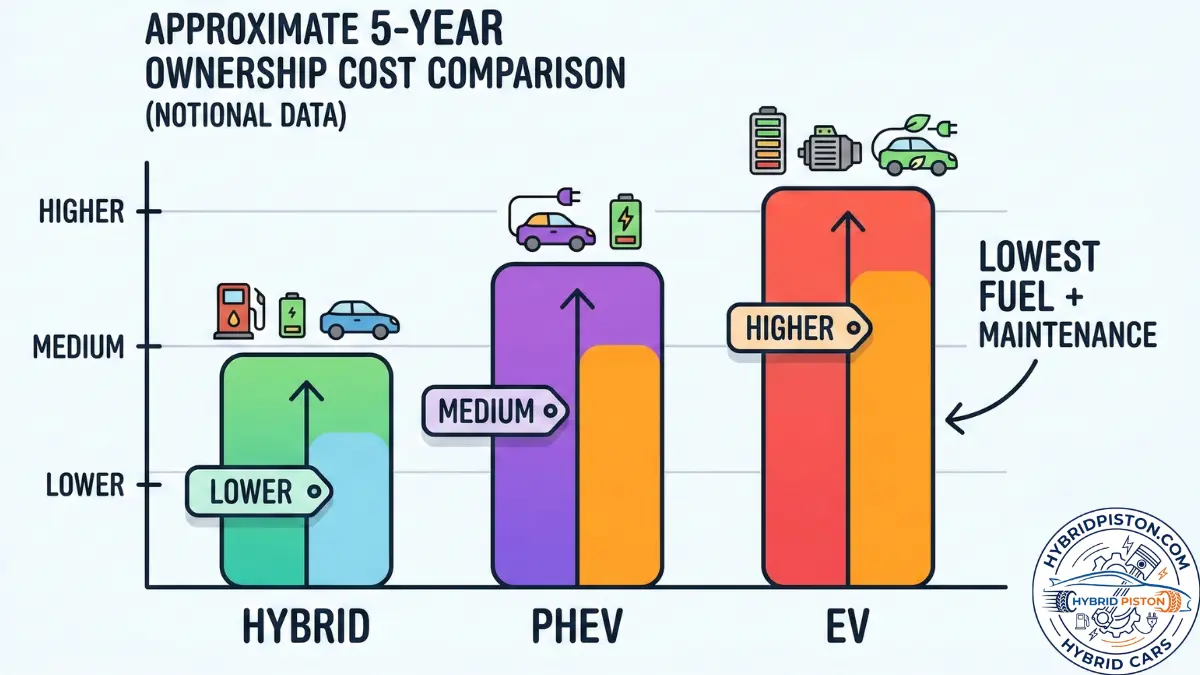
2025 cost‑of‑ownership analyses that combine purchase, fuel, maintenance, insurance, and depreciation often find:
- EVs have the lowest fuel and maintenance costs, but higher upfront price and insurance can leave total 5‑year costs slightly higher than hybrids in many segments.
- Hybrids often land at a sweet spot where total 5‑year costs are similar to or lower than equivalent gas and slightly lower than comparable new EVs.
- PHEV total cost depends heavily on how often they are actually plugged in; used mainly on gas, they may not beat a good hybrid.
Fuel and energy costs
Fuel and electricity prices are where hybrids, plug‑in hybrids, and EVs really separate themselves in day‑to‑day running costs. Even small differences in cost per mile add up quickly over 10,000–15,000 miles a year, so understanding how each powertrain uses energy is critical before you buy.
Cost per mile comparison
Recent 2025–2026 analyses that plug in average US gas and electricity prices show roughly this spread in energy cost per mile.
| Powertrain | Typical energy cost per mile | Approx. annual energy cost at 12,000 miles |
|---|---|---|
| EV | ~0.03–0.05 USD | ~360–600 USD |
| PHEV | ~0.05–0.09 USD | ~600–1,100 USD |
| Hybrid | ~0.06–0.08 USD | ~720–960 USD |
| Gasoline car | ~0.10–0.12 USD | ~1,200–1,440 USD |
These estimates assume home electricity around 0.16–0.20 USD/kWh and gasoline in the 3.00–3.50 USD/gal range.
How driving pattern changes the math
- If you mostly drive short trips under 20–40 miles and can plug in daily, a PHEV can operate almost as an EV for local use, burning very little gasoline.
- If you frequently take long highway trips with limited fast‑charging on your route, a hybrid gives predictable fuel stops and often excellent real‑world mpg, while a PHEV used mainly in hybrid mode may lose some of its advantage due to extra weight.
- If you drive 10,000–15,000+ miles per year and have home charging, an EV usually wins on energy cost, especially when most charging is at home or work rather than expensive DC fast chargers.
Maintenance, reliability, and complexity
For most buyers, the big differences between hybrids, plug‑in hybrids and EVs show up in how often they need service, what can go wrong long‑term, and how complex (or simple) the hardware is to live with.
Routine maintenance
- Hybrids and PHEVs still have an internal‑combustion engine, so they need oil changes, filters, and occasional spark plugs, but regenerative braking can extend brake life significantly compared with gas cars.
- EVs eliminate engine‑related maintenance entirely and generally have fewer moving parts, which is why their maintenance costs per year are widely reported as the lowest of the three.
Large ownership‑cost breakdowns commonly put 5‑year maintenance and repair costs for new EVs at 1,200–2,000 USD, versus roughly 2,500–3,500 USD for hybrids, depending on vehicle class and usage.
Long‑term battery and durability
All three powertrains depend on high‑voltage batteries, but with different sizes and stresses.
- Hybrids use relatively small packs that cycle frequently but are well‑proven, with many lasting 10+ years under warranty conditions.
- PHEV batteries are larger and more expensive to replace, though they often operate within moderate depth‑of‑discharge ranges.
- EV packs are largest and most expensive, but modern thermal management and long warranties (often 8–10 years) aim to keep them viable for typical first and second owners.
Out‑of‑warranty battery or power‑electronics failures can be costly for any of the three, but for most new‑car buyers within the warranty window, this is more of a resale‑value issue than an immediate ownership cost.
Charging and daily convenience
For many people, the winner between hybrid, plug‑in hybrid and EV is decided less by specs and more by how easy it is to keep the car fueled or charge-up in everyday life.
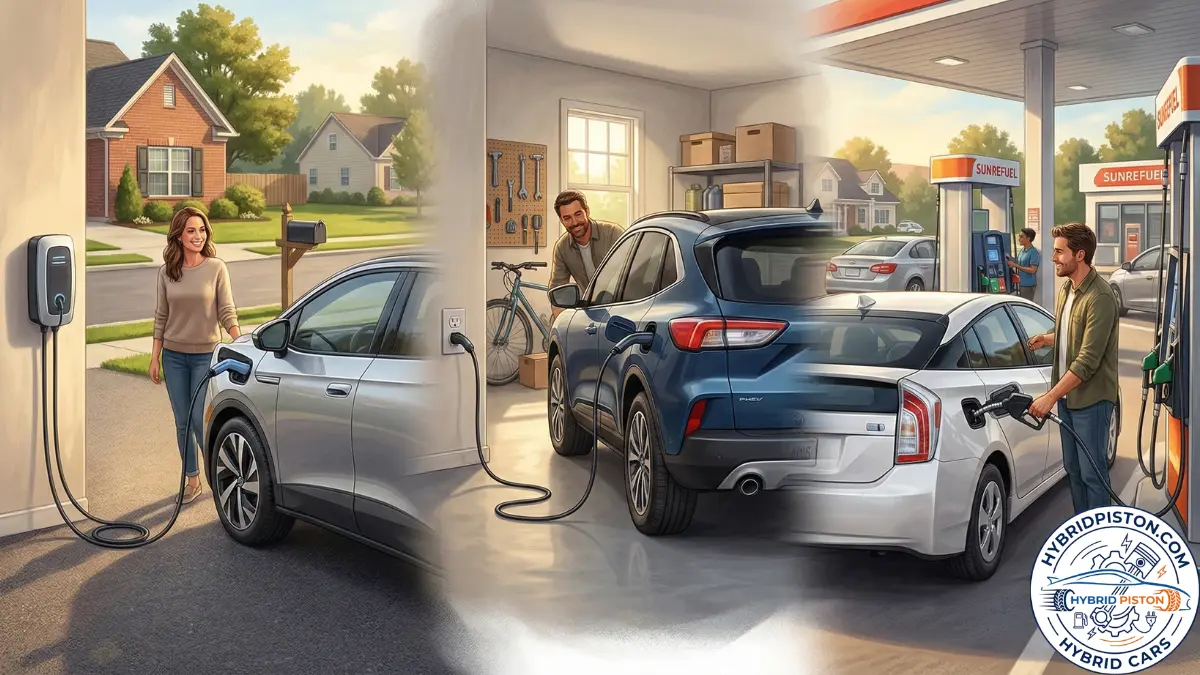
Who actually needs to plug in?
- Hybrids (HEV): Never need to plug in; they charge themselves while you drive.
- PHEVs: Need regular plugging in to deliver their promised electric‑only range and fuel savings; without plugging in, they behave like heavy hybrids.
- EVs: Always require charging; without home or workplace charging, relying solely on public infrastructure can be inconvenient in many regions.
Home vs Public Charging
Home charging is the single biggest factor in whether EVs and PHEVs feel convenient and cost‑effective.
- For PHEVs with 20–40 miles of range, even a standard 120V outlet can usually refill the battery overnight.
- For EVs with 60–100+ kWh packs, a 240V Level 2 charger at home is strongly recommended for daily usability; 120V can work only for low‑mileage drivers.
Public DC fast charging enables road trips but often costs more per kWh than home electricity, narrowing the operating‑cost gap vs hybrids and PHEVs when used heavily.
Environmental impact and emissions
From a tailpipe perspective:
- EVs have zero tailpipe emissions.
- PHEVs can run emissions‑free in EV mode for part of the time; real‑world impact depends on how often they are charged and driven electrically.
- Hybrids emit less than comparable gas‑only cars but still burn fuel all the time.
Lifecycle emissions (including electricity generation and manufacturing) vary by region and grid mix, but most independent analyses still place EVs lowest, then well‑used PHEVs, then hybrids, then gas‑only vehicles.
For buyers focused strongly on emissions, the key is behavior: a PHEV that is rarely plugged in may have higher real‑world emissions than a well‑driven hybrid.
Check-out emission report of the vehicle types and the powertrains
Pros and cons of HEV, PHEV, and EV
Choosing between a hybrid, plug‑in hybrid and EV isn’t just about technology names on a brochure it’s about what you gain and give up with each in daily use. The next sections lay out the key pros and cons for each option so you can match them to your own budget, driving pattern and charging situation.
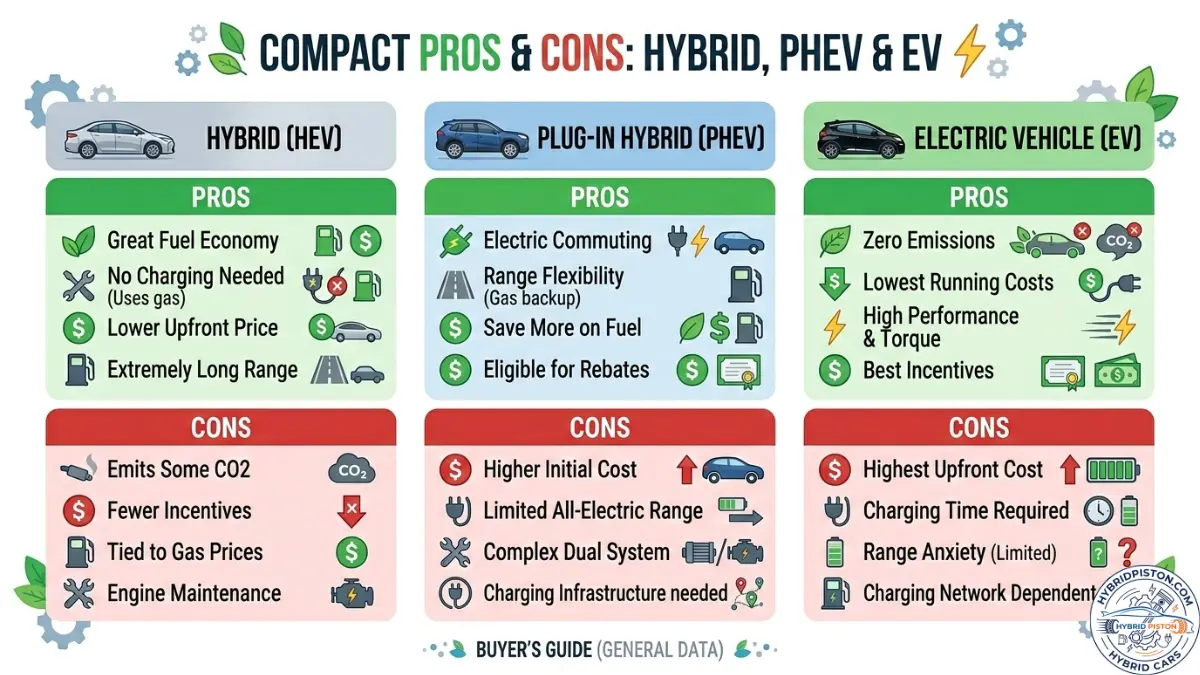
Hybrid (HEV)
Pros
- No lifestyle change: refuel at any gas station, no charging required.
- Better fuel economy than similar gas cars, especially in city driving.
- Typically lower sticker price than PHEVs and EVs.
- Mature, proven technology with many long‑term reliability examples.
Cons
- Still fully dependent on gasoline; minimal true electric driving.
- No federal EV tax credits for most models.
- Smaller emissions reductions than PHEVs and EVs when those are used properly.
Plug‑in hybrid (PHEV)
Pros
- Can do school runs and commutes on electricity only if charged regularly.
- Gasoline backup removes range anxiety on long trips.
- May qualify for EV‑style incentives depending on battery size and rules.
- Good transitional choice for buyers not ready for full electric.
Cons
- Highest hardware complexity: full engine, sizable battery, and charger.
- Purchase price often close to EVs and above regular hybrids.
- Real‑world savings and emissions strongly depend on plugging in often.
- Once the battery is depleted, they can be less efficient than a regular hybrid due to extra weight.
Battery‑electric vehicle (EV)
Pros
- Lowest energy and maintenance costs per mile when home charging is available.
- Zero tailpipe emissions and very quiet, smooth driving.
- Strong performance from instant electric torque.
- Increasing model choice and improving public charging networks.
Cons
- Typically the highest purchase price new, even after incentives.
- Requires reliable access to charging; long trips need route planning.
- Fast charging can be more expensive per mile than home charging and may affect battery aging over time.
- Insurance and repair costs are sometimes higher due to expensive batteries and bodywork.
Matching tech to common USA driver profiles
Different drivers need different things, so it’s easier to pick the right powertrain if you first see which “typical US driver profile” looks most like you.
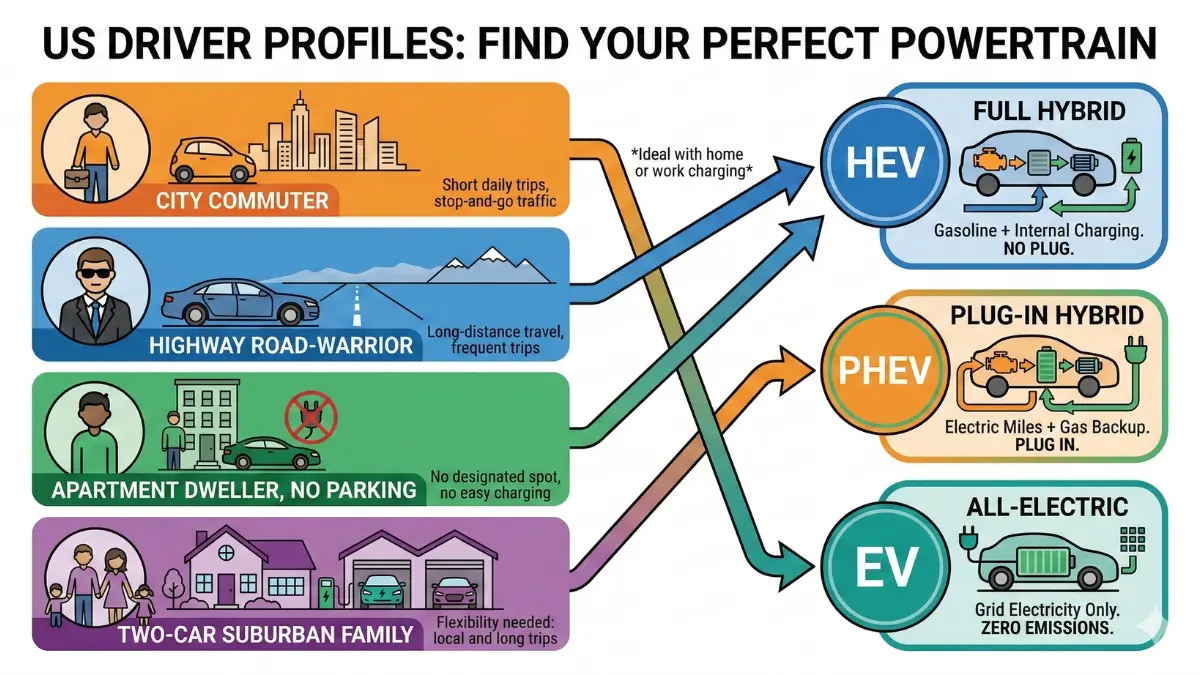
| Driver Profile | Best fit | Why |
|---|---|---|
| Apartment dweller with street parking, no outlet, mixed city/highway | Hybrid (HEV) | No charging required, solid mpg, minimal lifestyle change |
| Suburban commuter, 20–40 miles/day, garage or driveway outlet | PHEV or EV | Daily driving mostly electric; PHEV keeps gas backup for trips |
| High‑mileage highway driver (sales, long trips), limited fast‑chargers | Hybrid (HEV) or efficient PHEV | Excellent highway mpg, quick gas refuelling, fewer charging stops |
| Two‑car household, one mostly for local errands, home Level 2 charger | EV + hybrid/PHEV | EV handles local miles cheaply; hybrid/PHEV covers long trips |
| Environment‑focused driver in state with strong EV incentives and clean grid | EV | Lowest lifecycle emissions and running costs with good charging |
5‑Step Decision Guide for 2026 US Car Buyers
A lot of the confusion disappears when you run through a simple, step‑by‑step checklist instead of just going by hype or gut feel. Use this framework to sanity‑check whether a hybrid, plug‑in hybrid or EV actually fits your driving pattern, charging situation and budget for the next 5–10 years.
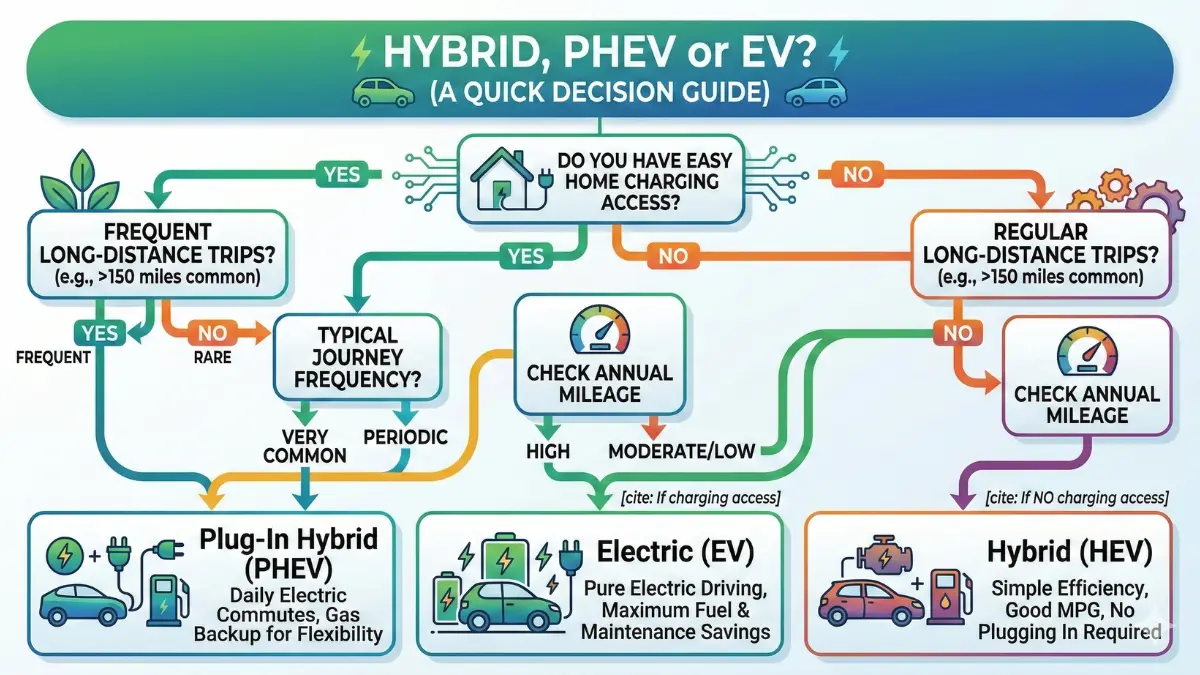
- Check your charging reality first.
- Home/work charging available now or within a year? EV or PHEV becomes realistic.
- No reliable charging for several years? Focus on hybrids and efficient gas models.
- Map a typical week of driving.
- Mostly short trips under 20–40 miles: PHEV or EV can do most miles on electricity.
- Frequent long highway runs: Hybrids or PHEVs in hybrid mode may be more practical.
- Run a 5‑year cost comparison.
Take at least one hybrid, one PHEV, and one EV you’re considering. Compare:- Purchase price (minus any incentives)
- Estimated 5‑year fuel/energy cost using your mileage and local prices
- Insurance quotes
- Expected maintenance (using brand reliability data)
Tools like ownership‑cost calculators and trustworthy buying guides can help plug in real numbers.
- Decide your ownership horizon.
- If you keep cars 3–5 years, running‑cost differences matter less than depreciation and incentives.
- If you keep cars 8–10+ years, fuel and maintenance savings compound; hybrids and well‑chosen EVs often win.
- Weigh non‑financial priorities.
- Quietness, performance, emissions, and future regulations may justify an EV even if it is slightly more expensive on paper.
- Simplicity, long‑distance flexibility, and familiarity may keep many buyers in the hybrid camp for the rest of the 2020s.
What buyers ask us most
Should I buy a hybrid or plug-in hybrid if I don’t have home charging?
Regular hybrids (HEV) are your best bet no plug needed, just fill up gas like normal. Plug-in hybrids only make financial sense if you can charge daily to use their electric range.
What’s cheaper to own long-term: hybrid, plug-in hybrid, or EV?
Hybrids usually win 5-year total ownership cost because they avoid high EV upfront prices and PHEV battery complexity. EVs can compete if you drive 15,000+ miles/year and have cheap home electricity.
Can I take a plug-in hybrid or EV on long road trips across states?
Yes, but plan ahead. Hybrids have unlimited range (just gas stations everywhere). PHEVs get 30-50 electric miles then act like hybrids. EVs need DC fast chargers every 150-250 miles, which adds 20-40 minutes per stop.
Do hybrids and EVs really save money on maintenance vs gas cars?
Hybrids save ~30% on brake repairs (regenerative braking) but have slightly higher routine service costs. EVs save the most (~50% less maintenance) because no oil changes, transmissions, or spark plugs but battery repairs are expensive if needed.