
Hybrid cars are vehicles that use both a gasoline engine and an electric motor to move the car, instead of relying on just one power source. This combination helps improve fuel economy, reduce emissions, and offer a smoother drive, especially in city traffic. In the USA, hybrids have become a popular “middle ground” between traditional gas cars and fully electric vehicles because they do not depend on public chargers but still offer major efficiency benefits.
The first mainstream hybrid in the US was the Toyota Prius around 2000, and it proved that Americans would accept fuel‑efficient technology if it lowered running costs and fit daily life. Since then, almost every major brand like Toyota, Honda, Hyundai, Ford, Lexus, and others, has launched hybrid models in sedans, SUVs, and even off‑road vehicles. Today, hybrids are no longer a niche; they are a core part of the modern US car market.
What exactly is a Hybrid car
A hybrid car uses two power systems working together:
- An internal combustion engine (ICE) that runs on gasoline
- One or more electric motors powered by a high‑voltage battery pack
Unlike a regular gas car, a hybrid can move the vehicle using the engine, the electric motor, or both at the same time. The high‑voltage battery in a conventional hybrid is not plugged into a charger; instead, it is automatically recharged by the engine and by a system called regenerative braking when you slow down or brake.
The main difference between hybrids, plug‑in hybrids (PHEVs), and full EVs is how much they depend on gasoline and charging:
- Hybrids: Cannot be plugged-in, they totally rely on gas and automatic charging from driving.
- Plug‑in hybrids: Have larger batteries that you can plug in, so they can drive dozens of miles on electricity before the engine kicks in.
- EVs: Use only batteries and electric motors and must be charged from the grid; they have no gasoline engine.
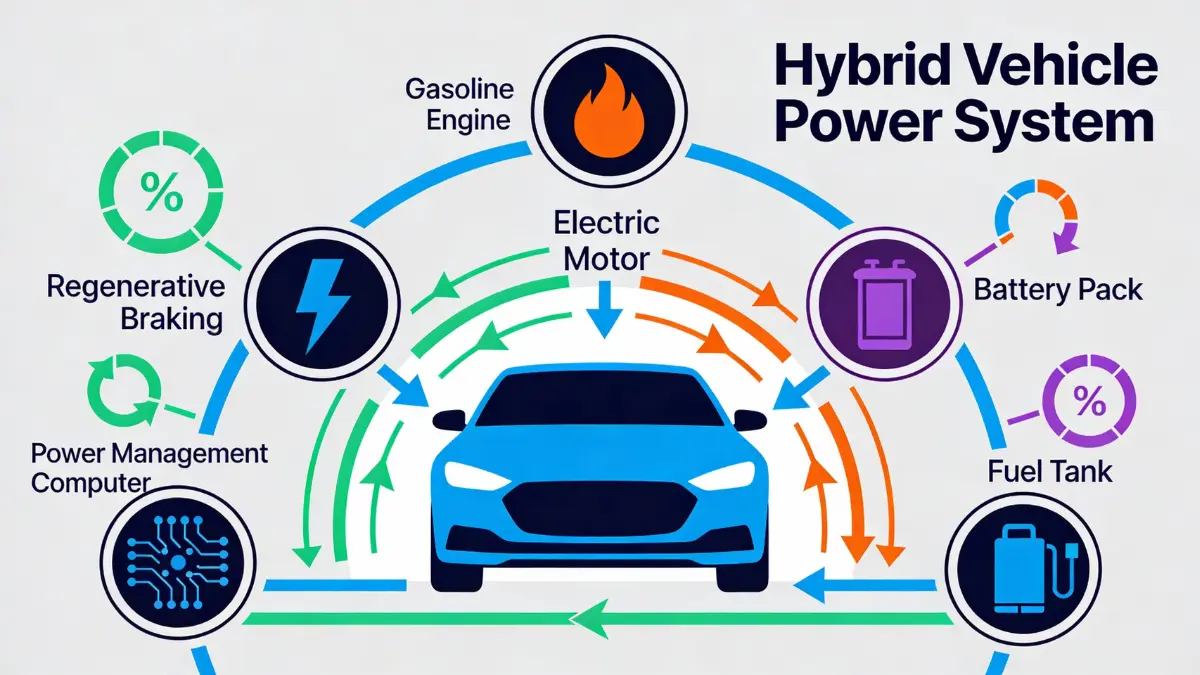
How a Hybrid Car Works
The easiest way to understand how hybrid cars work is to imagine a normal day of driving.
You start the car in the morning, pull out of your parking spot, and the first few metres are usually powered by the electric motor, so the car glides almost silently. There’s no engine noise, just smooth acceleration. This is one of the reasons city drivers love hybrids at low speeds (typically under 25-30 mph), the electric motor does most of the work.
As you build up speed or need more power, the petrol engine wakes up, and the two systems work together, giving you smooth acceleration without burning fuel. When you’re cruising on the motorway at a steady 60 mph, the engine usually takes over because that’s when it’s most efficient, though the motor stands by to help if you need it.
Then comes the clever bit: when you come up to a red light and lift off the accelerator, the hybrid does something brilliant. Instead of turning all that motion into heat in the brakes, it uses the electric motor as a generator, turning your car’s momentum back into electricity and topping up the battery. This is called regenerative braking, and you don’t have to press any extra buttons to use it. The system even blends this regenerative braking smoothly with your mechanical brakes, so it feels completely normal when you brake.
Main Parts That Make it Work
Petrol Engine: Smaller and lighter than a regular car’s engine because the electric motor is helping out. It runs at its most efficient speed most of the time.
Electric Motor: Powered by the battery, it provides instant power and helps during acceleration or city driving. Modern hybrids often have more than one motor doing different jobs.
Traction Battery Pack: A high-voltage battery (usually under the rear seats) that stores energy from braking and the engine. It’s typically much smaller than an EV battery because it’s not the only power source. Most hybrid batteries are designed to last 8-10+ years or over 100,000 miles.
The Computer (ECU): This is the brain that makes all the decisions. It’s constantly monitoring battery charge, engine temperature, how hard you’re pressing the accelerator, and road conditions, then it instantly decides what combination of engine and motor to use for maximum efficiency.
Regenerative Braking System: When you brake or coast, the motor reverses its function to become a generator, capturing energy that would normally be wasted and putting it back into the battery. This can extend your range by several miles each day in city driving.
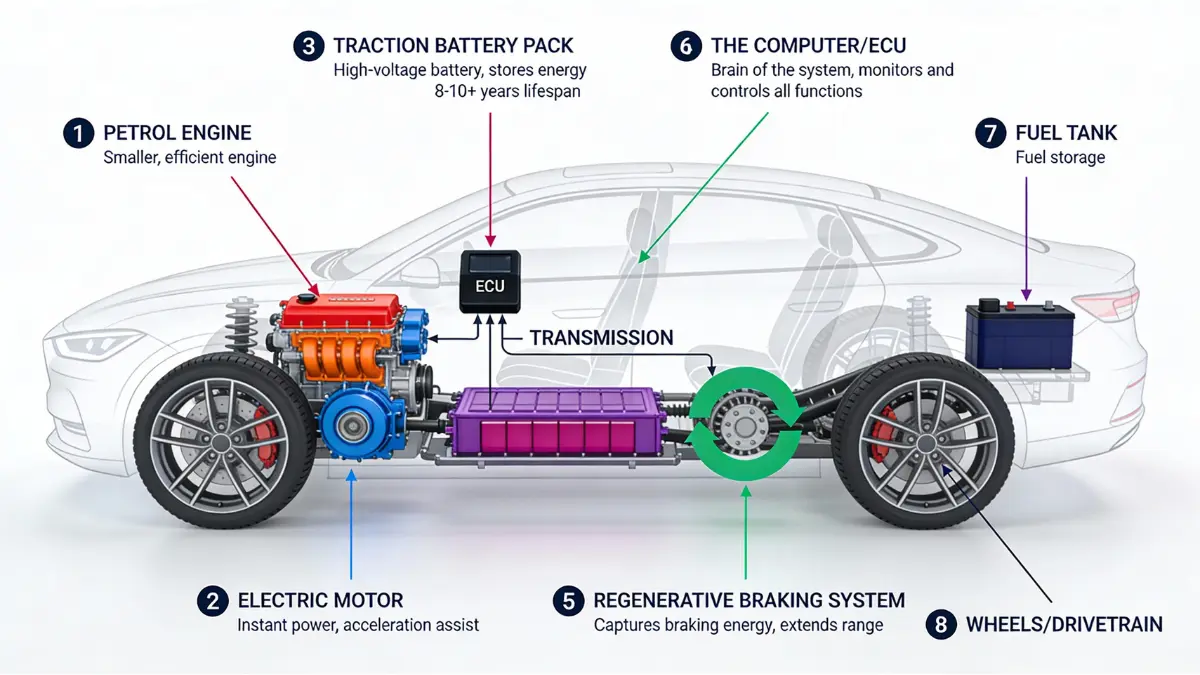
Working in Different driving situations
Stopping and starting in traffic: Hybrids usually pull away on electric power only, so you get quiet, smooth movement with no engine noise or gear changes. Because the engine often stays off at low speeds, you burn far less fuel than a normal petrol car in stop‑and‑go conditions.
Moderate cruising: At steady town speeds, the petrol engine does most of the work while the electric motor quietly helps when needed, like on small inclines. This keeps revs low, saves fuel, and makes the drive feel calmer and smoother than a typical non‑hybrid
Hard acceleration or climbing a hill: When you press the pedal firmly, the engine and electric motor work together to give a strong, instant push. The motor’s instant torque fills in the gaps, so a hybrid with a smaller engine can feel as lively as a larger traditional petrol car.
Slowing down or braking: As soon as you lift off the accelerator or brake gently, the electric motor switches into generator mode and recovers energy that would normally be wasted as heat. That captured energy is stored in the battery and later reused for acceleration, improving overall efficiency.
Sitting at a red light: If the battery has enough charge, the engine simply shuts off instead of idling, so you’re using no fuel while you wait. When the light turns green, the electric motor can move the car immediately, and the engine only restarts when the system decides it’s actually needed.
The whole process happens seamlessly without any input from you. You just drive like a normal automatic car, that’s the beauty of hybrid cars
Types of Hybrid Cars
Not all hybrids are the same. There are a few different approaches to combining petrol and electric power
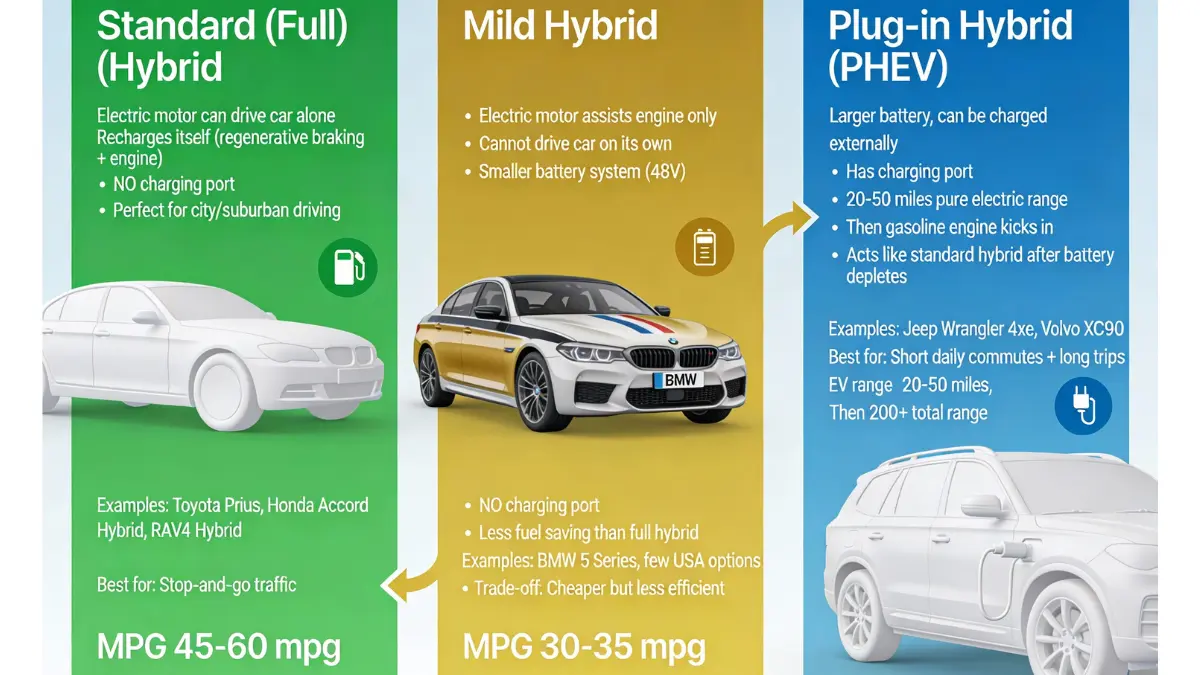
Standard (Full) Hybrid
This is what most people mean when they say “hybrid.” The electric motor can power the car alone at low speeds, and it recharges itself through regenerative braking and the engine. So no charging port is needed. These are perfect for city and suburban driving where you’re constantly stopping and starting.
Examples: Toyota Prius, Honda Accord Hybrid, Toyota RAV4 Hybrid, Hyundai Elantra Hybrid.
Mild Hybrid
A mild hybrid has an electric motor and battery, but the motor can’t actually drive the car on its own, it just assists the engine. This is a smaller step toward efficiency without the full benefits of a proper hybrid system. Very few mild hybrid cars are available in the USA market, like the BMW 5 Series (530li) uses a 48-volt system with a belt-driven starter generator to boost performance.
Trade-off: Cheaper than a full hybrid, but less fuel saving.
Plug-in Hybrid (PHEV)
This has a bigger battery and a charging port, so you can plug it in at home or at a charging station. You can drive 20-50 miles on pure electricity before the petrol engine kicks in, it’s purely based on your driving pattern/style. After that, it behaves like a standard hybrid.
Best for: People with predictable short commutes who can charge at home but want the security of a petrol engine for longer trips.
Examples: Kia Sorento Plug-in Hybrid, Toyota RAV4 Plug-in Hybrid
Pros and Cons of Hybrid Cars
This is the deciding factor for most of us to buy a hybrid vehicle, which is very important to know before we make any buying decision of a hybrid car.
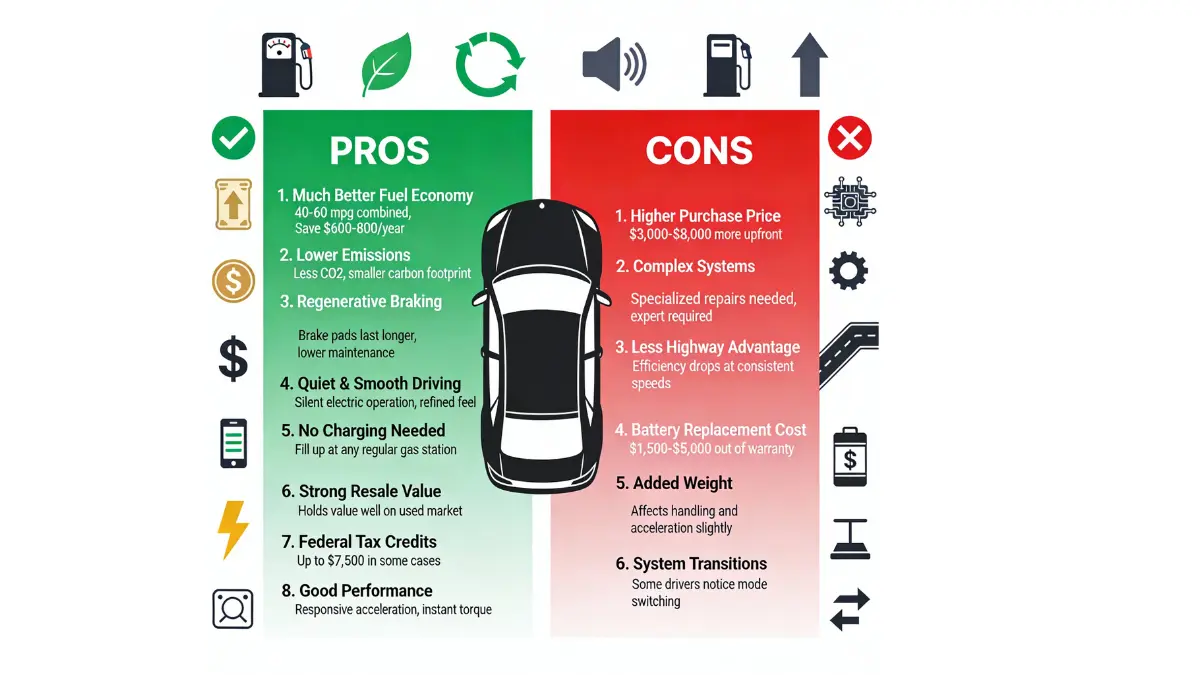
Pros of Hybrid Cars: Why People Buy Them
1. Much Better Fuel Economy (Especially in the City)
This is the biggest reason people choose hybrids. In stop-and-go city traffic where conventional engines are least efficient, hybrids absolutely shine. Many modern hybrids achieve 40-60 mpg combined, sometimes even higher, compared to just 25-28 mpg for a similar non-hybrid car.
The numbers add up fast: if you drive 12,000 miles a year and petrol costs around $3 per gallon, you could save $600-$800 per year in fuel compared to a conventional vehicle. Over 5-7 years, you can achieve the break-even point, which is real money that can offset the higher purchase price.
2. Lower Emissions, Less Environmental Impact
Because the engine isn’t working as hard and the car can move on electric power at times, hybrids emit less CO₂ and fewer pollutants than similar petrol-only cars. You still have a tailpipe, but your footprint is noticeably smaller, especially if most driving is around town.
For environmentally conscious drivers, this is a meaningful difference without requiring the infrastructure planning of a full EV.
3. Regenerative Braking Means Brake Pads Last Much Longer
This is an underrated benefit. Because the electric motor handles much of the slowing down, your mechanical brake pads wear much more slowly. Many hybrid owners report brake pads lasting significantly longer, sometimes for the entire life of the vehicle, compared to just 40,000-50,000 miles on a regular car.
This saves money on maintenance and makes braking feel smoother and more refined.
4. Quiet and Smooth Driving
At low speeds, especially in city driving, the electric motor operates silently. There’s no engine noise, no vibration, just smooth, quiet acceleration. Many drivers find this creates a more pleasant driving experience, particularly in urban environments.
5. No Need for Charging Infrastructure
Standard hybrids don’t need charging stations, home chargers, or any planning around charging. You fill up with petrol at any regular fuel station, just like always. This matters enormously if you live in an apartment, don’t have a garage, or live somewhere with limited charging infrastructure.
6. Strong Resale Value
Hybrids, especially from Toyota and Honda, hold their value well on the used market. Buyers know these cars are economical, reliable, and often have lower mileage on the engine. This means you’ll recoup more of your purchase price when it’s time to sell or trade in.
7. You Get Federal Tax Credits (Sometimes)
Depending on the model and your income, you might qualify for federal tax credits up to $7,500, though rules change frequently. This can substantially reduce the effective purchase price and make hybrids much more competitive on cost.
8. Good Performance, Not Compromised
Modern hybrid systems don’t sacrifice power. Many hybrids offer impressive acceleration and torque because the electric motor adds instant power. You’re not driving a slow or wimpy car now; hybrids can feel responsive and fun to drive.
Cons of Hybrid Cars: People’s Deciding Factor
1. Higher Upfront Purchase Price
The big downside is the price tag. Compared to a non-hybrid version of the same car, the hybrid often costs $3,000-$8,000 more because of the battery, motor, and electronics. Over time, fuel savings can close that gap, but if you don’t drive much, plan to own the car only 2-3 years, or drive mostly on motorways, you might not fully recover the difference.
2. Extra Complexity Under the Bonnet
Day to day, a hybrid feels as simple as any automatic car, but the technology under the hood is more complex. Most routine maintenance is straightforward, but if something serious goes wrong in the hybrid system after the warranty expires, you’ll want a workshop that actually understands high-voltage hybrid systems. Not every corner garage will have the right expertise.
3. Less Advantage on Long Highway Drives
On pure highway driving at consistent speeds, the hybrid’s efficiency advantage shrinks dramatically because there’s no stop-and-go traffic and minimal regenerative braking opportunity. The petrol engine is doing most of the work at that point, so you won’t see the dramatic 40+ mpg figures you get in the city.
4. Battery Replacement Could Be Expensive (Eventually)
While hybrid batteries are designed to last 8-10+ years or over 100,000 miles, and most make it beyond that, if battery replacement is needed out of warranty, it can cost several thousand Dollars depending on the model. This is relatively rare with modern batteries, but it’s a potential risk to consider if you plan to own the car for 12+ years.
5. Slightly More Weight
Hybrid vehicles carry extra weight from the motor, battery, and supporting systems. This added weight can slightly affect handling and acceleration feel compared to an equivalent non-hybrid car, though most drivers won’t notice much difference in day-to-day driving.
6. Sometimes You Notice the Transition Between Systems
While rarely problematic, some drivers notice a slight hesitation or feel change when the engine engages while you’re already accelerating, or when the systems switch modes. Modern hybrids have minimised this significantly, but extremely sensitive drivers occasionally report noticing these transitions.
Popular hybrid car models available in the USA
This is the top 5 Hybrid cars, which include Hybrid and Plug-in hybrid sales in USA till january 2026
| Model | Type | MPG | Key benefit | Sold in 2025 |
|---|---|---|---|---|
| Toyota RAV4 | SUV | 38-39 | Popular, Reliable, versatile | 181,433 |
| Honda CR-V | SUV | 37-40 | Refined and Spacious | 217,929 |
| Toyota Camry | Sedan | 48-50 | Fuel efficiency with refine drive | 316,185 |
| Honda Civic | Sedan | 48-49 | Sporty drive and efficiency | 86,407 |
| Toyota Corolla | Sedan | 46-50 | Compact, affordable, proven reliability | 50,245 |
People actually ask about Hybrid Cars
Do I need to charge a hybrid car, or does it charge itself?
Standard hybrids don’t need charging they recharge themselves through regenerative braking and the engine while you drive. Plug-in hybrids (PHEVs) have a charging port for optional external charging.
How long do hybrid batteries actually last, and what’s the warranty?
Most hybrid batteries are warranted for 8–10 years or 100,000+ miles. Toyota offers 10 years/150,000 miles on hybrid batteries, and real-world data shows most batteries last well beyond warranty periods with minimal degradation.
Are hybrid cars cheaper to maintain than regular cars?
Yes – hybrids have significantly lower maintenance costs because regenerative braking reduces brake wear dramatically, and the smaller engine runs fewer hours and with less stress.
Can a hybrid car make long road trips, or is it only for city driving?
Hybrids work fine for road trips since they still use gasoline and refuel at regular stations. However, fuel economy advantages are strongest in city/suburban driving; highway efficiency is more modest
What’s the difference between a hybrid and a plug-in hybrid (PHEV)?
Standard hybrids can’t be plugged in and have no all-electric range. Plug-in hybrids have a charging port and can drive 20–50 miles on pure electricity before the engine engages.
Are hybrid cars reliable, or do they have more problems?
Yes, hybrids from established makers (Toyota, Honda, Hyundai) are extremely reliable. Industry experts rate modern hybrids as “extremely reliable,” with fewer issues than plug-in hybrids or EVs.
How do hybrids perform in cold winter weather?
Hybrids work in cold weather, but fuel economy drops 10–20% in freezing temperatures because batteries have less available energy in extreme cold. They still deliver better cold-weather efficiency than conventional vehicles.