
In 2026, we’ve reached a tipping point. For over a decade, the “Hybrid vs. Gas” debate was mostly about fuel economy and being “green.” But today, the conversation has shifted. With the average new car price hovering near $49,000 and the introduction of new 2026 tax regulations, buying a hybrid is now a high-stakes financial calculation.
If you’re standing in a dealership lot wondering if that extra $3,500 for the hybrid badge is a smart investment or just a “green tax,” you aren’t alone. In this guide, we’re going to strip away the marketing fluff and look at the real-world costs of hybrid ownership in 2026.

The Upfront Cost: The Hybrid Premium
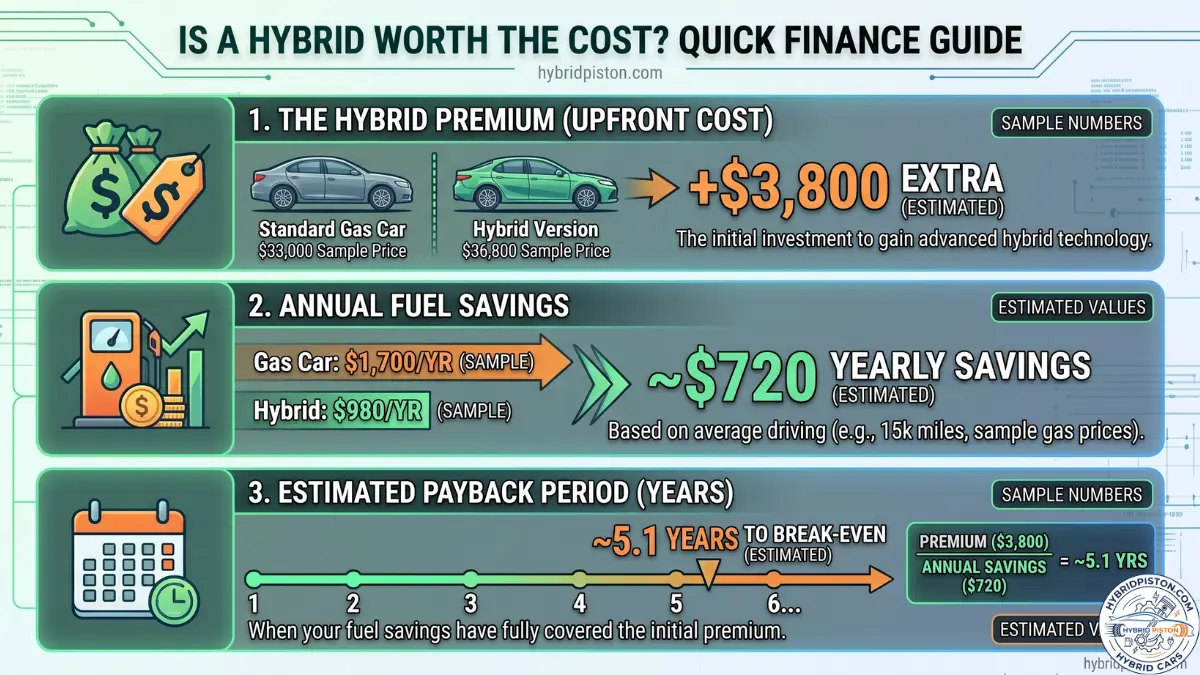
Let’s start with the immediate hit to your wallet. In 2026, a “Hybrid Premium” still exists, though it’s smaller than it used to be. On average, a hybrid version of a popular SUV or sedan will cost between $2,800 and $4,200 more than the equivalent gasoline model.
Why the Gap Persists
Even though battery prices have dropped significantly (now averaging around $80/kWh), the complexity of a hybrid remains high. You are essentially paying for two distinct power systems: a high-efficiency internal combustion engine (ICE) and a sophisticated electric motor/battery setup.
- Compact SUV (Gas): ~$32,500
- Compact SUV (Hybrid): ~$36,300
- The “Gap”: $3,800
The 2026 Reality: If you are financing at a 6% interest rate, that premium adds roughly $75 to your monthly payment. To make the hybrid worth it, you need to find at least $75 in savings elsewhere every single month.
Fuel Savings: Does the Math work
In 2026, fuel prices have stabilized but remain a major household expense. The average 2026 gas-powered sedan achieves about 29 MPG, while the hybrid equivalent easily clears 52 MPG.
The Simple Equation (15,000 Miles/Year)
- Gasoline Car: Uses ~517 gallons per year. At $3.35/gal = $1,731/year.
- Hybrid Car: Uses ~288 gallons per year. At $3.35/gal = $965/year.
- Annual Savings: $766.
The Payback Period: At $766 in annual savings, it takes 4.9 years to pay off the initial $3,800 premium through fuel alone. If you keep your cars for 6 to 10 years, the hybrid is a clear financial winner. If you trade in every 3 years, the fuel savings won’t cover the extra cost.
You can check-out How hybrid cars work and their Pros and Cons
Maintenance: The Hidden Profit
This is where the “Is it worth it?” answer usually changes to a “Yes.” Most people assume hybrids are more expensive to maintain. In 2026, data shows the opposite.
The Brake Miracle
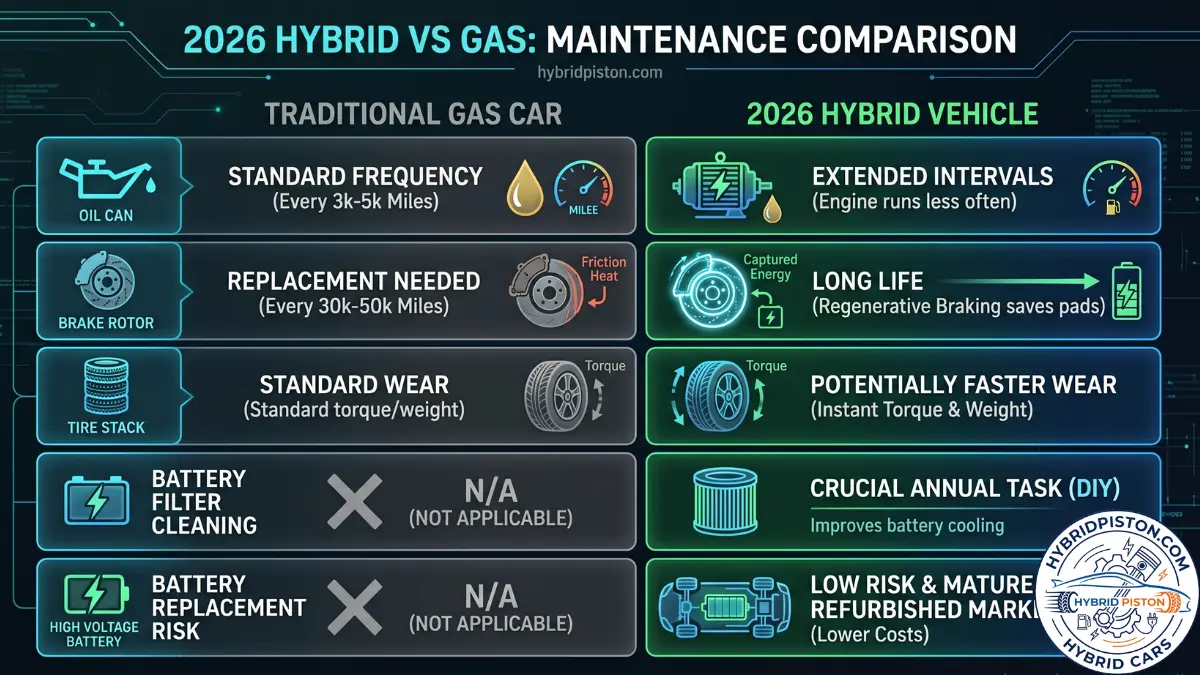
Hybrids use regenerative braking. When you lift your foot off the gas, the electric motor slows the car down to recharge the battery. This means the physical brake pads and rotors are used significantly less. It is now common for 2026 hybrid owners to reach 100,000 miles before needing their first brake job. In a gas car, you’d likely have spent $1,200 on two or three brake services by that point.
Reduced Engine Load
Because the electric motor handles the high-stress tasks like pulling away from a stop sign, the gasoline engine in a hybrid doesn’t work as hard. This leads to fewer cooling system issues, longer-lasting belts, and overall less engine fatigue.
The eCVT: A Transmission with No Gears to Break
Most modern hybrids (especially those from Toyota and Honda) use an eCVT (Electronic Continuously Variable Transmission). Unlike a traditional automatic transmission with hundreds of tiny moving parts and clutches that can wear out, an eCVT is shockingly simple.
- No Belts or Pulleys: Unlike a standard CVT found in many gas cars, an eCVT uses a single “planetary gear set” and two electric motors. There is no belt to slip or snap.
- Maintenance: In 2026, many of these units are considered “lifetime” components, requiring only a fluid change every 60,000 to 100,000 miles. It is arguably the most reliable transmission ever designed.
The Tire Tax: Where Hybrids Cost More
it’s not all savings. Hybrids are significantly heavier than gas cars (due to the battery pack) and provide instant torque (the electric motor pushes the car forward immediately).
- Faster Wear: 2026 data shows that hybrid tires can wear out 15% to 20% faster than those on a gas car.
- Replacement Cycle: Where a gas sedan might get 45,000 miles on a set of tires, a hybrid owner might find themselves at the tire shop by 30,000 miles.
- Pro Tip: Recommend that they use EV-specific tires, which are designed with stiffer sidewalls to handle the extra weight and torque.
The Battery Filter Maintenance
Here is a “Pro Tip” that most owners don’t know: Most 2026 hybrids have a dedicated air filter for the battery cooling system (usually located under or near the rear seats).
- The Cost of Neglect: If this filter gets clogged with pet hair or dust, the battery overheats. An overheated battery works less efficiently and dies years earlier.
- Simple DIY: This is a 5-minute task. Cleaning or replacing this $20 filter once a year is the single best way to avoid a $5,000 battery replacement bill.
Maintenance Comparison (Annual average)
| Maintenance Task | Gas Car (2026) | Hybrid Car (2026) |
| Oil Changes | 2 per year (~$180) | 1-2 per year (~$150) |
| Brake Pads/Rotors | Every 3-4 years (~$600) | Every 8-10 years (~$600) |
| Tires | Every 4-5 years (~$800) | Every 3 years (~$900) |
| Belts & Alternator | Periodic (~$400) | N/A (Electric) |
| Battery Filter | N/A | Annual Cleaning ($20) |
The Battery Anxiety: Is it Justified
The biggest “Con” in every hybrid discussion is: What happens when the battery dies?
In 2026, this fear is largely outdated. Federal law now requires hybrid batteries to be warranted for 8 years or 100,000 miles (10 years/150,000 miles in California-emission states). If you are buying new, you will likely never pay a cent for a battery.
Out-of-Warranty Costs in 2026: If you buy used or keep the car for 15 years, a full battery replacement now costs:
- New OEM Battery: $4,000 – $6,500
- Reconditioned/Refurbished: $1,500 – $2,800
With a thriving secondary market for battery cells, a “dead battery” is no longer a death sentence for the car it’s comparable to a major transmission repair on a gas vehicle.
Resale Value: The 2026 Gold Mine
This is the most overlooked factor is resale value in the “Is it worth it?” debate. In 2026, used hybrids are in massive demand.
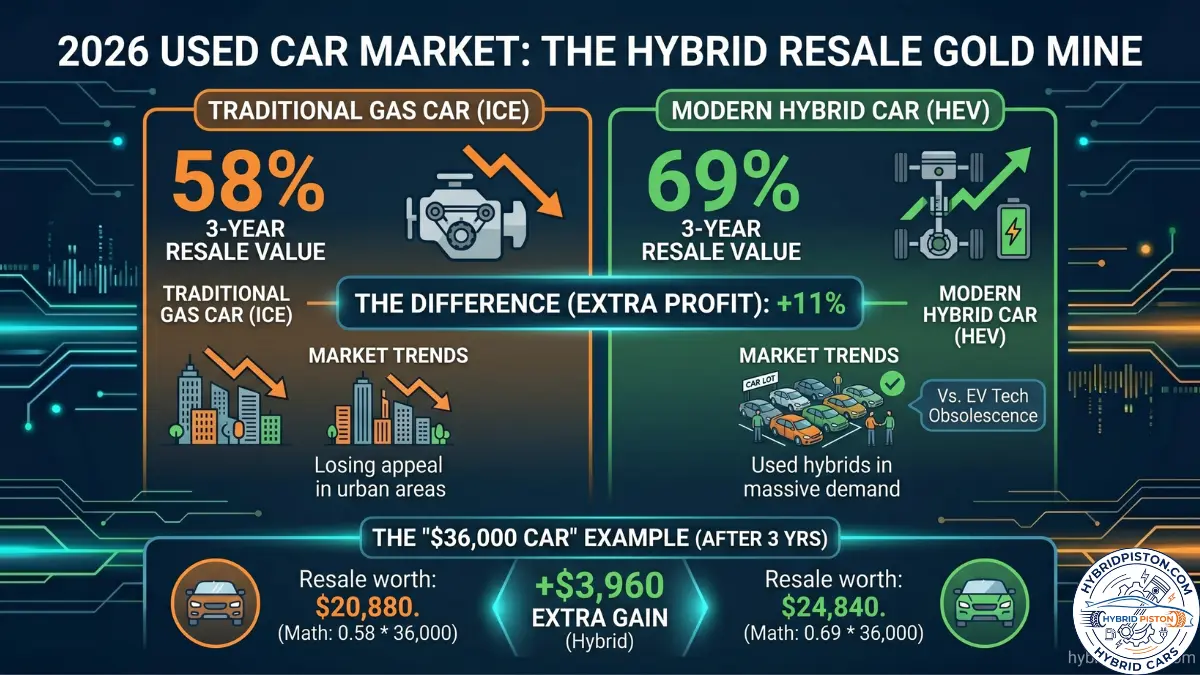
While EVs suffer from “tech obsolescence” (where older models feel dated quickly) and gas cars are losing appeal in urban areas, hybrids hold their value better than almost any other segment.
- 3-Year Resale (Gas): ~58% of original value.
- 3-Year Resale (Hybrid): ~69% of original value.
On a $36,000 car, that 11% difference in resale value is $3,960. This effectively erases the $3,800 “Hybrid Premium” the day you sell the car.
The Hidden Fees: Insurance and Registration
Before you sign the papers, you must account for the two areas where hybrids are more expensive.
Higher Insurance Premiums
Expect to pay 8% to 12% more for hybrid insurance. Insurers charge more because hybrids have higher replacement costs and require specialized technicians for repairs after an accident.
How much does hybrid insurance cost in 2026
The Recalibration Cost: In 2026, hybrids are packed with Advanced Driver Assistance Systems (ADAS). A simple “fender bender” that used to cost $500 for a new bumper now often costs $2,500+. Because the sensors (LiDAR, Radar, and Cameras) embedded in that bumper must be precision-recalibrated. A single sensor recalibration in 2026 typically bills at $250 to $500, and most hybrids have four or more.
State Registration Surcharges
In 2026, over 30 states have implemented “Electrified Vehicle Fees” to make up for lost gas tax revenue. These fees range from $100 to $250 annually. Check your local DMV website before doing your final math.
The Rise of Indexing: States like California, Michigan, and Mississippi have moved to “indexed” fees. This means your registration fee now rises automatically every year based on the Consumer Price Index (CPI) or state gas tax increases no new law required.
Michigan’s New Crown: As of January 2026, Michigan has become one of the most expensive states for hybrid owners, with surcharges spiking to over $110 for hybrids and nearly $270 for EVs/PHEVs to fund aggressive road repair initiatives.
Hybrid vs Gas Car Cost Comparison
This table is the cold, hard math that helps you decide if you’re actually saving money or just paying for a fancy badge in today’s market. It highlights the tipping point where the “Hybrid Premium” stops being an extra expense and starts becoming a long-term profit through lower maintenance and superior resale value.
| Factor | Hybrid Car | Gas Car | Winner |
| MSRP | $36,300 | $32,500 | Gas |
| Annual Fuel | $965 | $1,731 | Hybrid |
| Annual Maintenance | $680 | $950 | Hybrid |
| Annual Insurance | $1,850 | $1,650 | Gas |
| 3-Year Resale Value | $25,000 | $18,800 | Hybrid |
| Total 3-Year Cost | $21,535 | $23,543 | Hybrid |
The Final Conclusion
After crunching the numbers, looking at the 2026 tax codes, and speaking with technicians who deal with these cars every day, the answer isn’t a simple “yes” but it’s a very loud.
Here is the cold, hard truth: If you are buying a hybrid solely to “save the planet,” you’re making an emotional choice. If you’re buying it to save money, you’re making a mathematical one. And in 2026, the math has finally caught up to the marketing.
The Mechanical Peace of Mind
What most people miss in this debate is the simplicity factor. Yes, the high-voltage system is complex, but the removal of the “legacy” parts the starter, the alternator, the serpentine belt, and the AC compressor belt removes the most common reasons cars end up in the shop between 60,000 and 100,000 miles. You aren’t just buying better gas mileage; you’re buying an engine that doesn’t have to work nearly as hard.
The Hidden Tax Reality
You have to be prepared for the 2026 “Hybrid Tax.” Between higher insurance premiums due to expensive LiDAR sensors and those annoying state registration surcharges, your first $500–$700 of fuel savings every year is essentially “pre-spent.” You only start seeing true profit in your pocket after you cross the 10,000-mile mark annually.